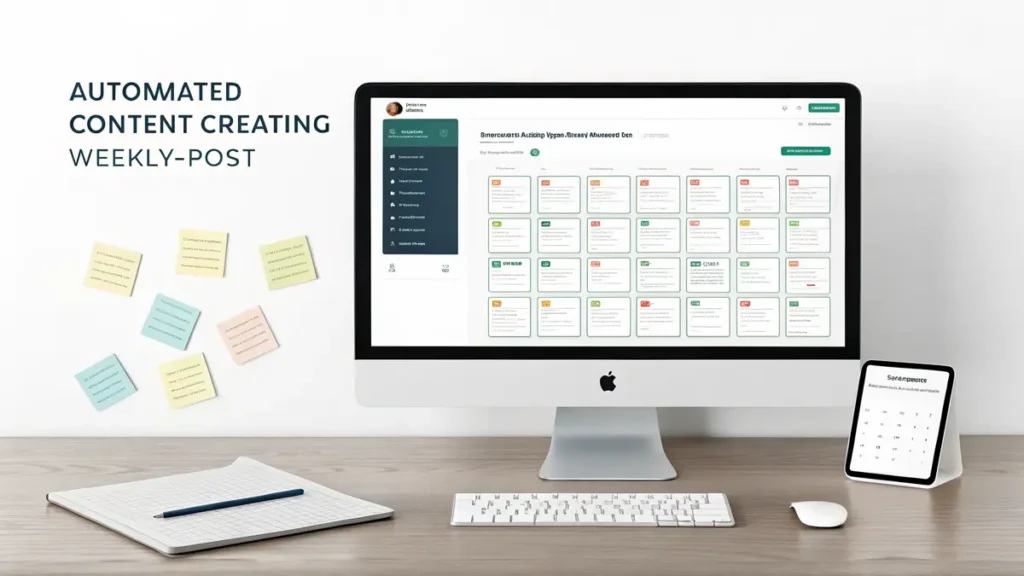

Automated content creation is right for your business if you need consistent marketing output but still want to sound human. The key is using automation for structure, repurposing, and publishing while keeping your brand voice, customer insight, and final message under human control.
If you are asking whether automated content creation will make your business sound robotic, the honest answer is: it depends on how you use it. Automation is not the problem by itself. The real issue is whether your content system is built around your actual voice, audience, and offers—or whether it is just pushing out generic posts at scale.
For many businesses, the bigger problem is not sounding too automated. It is disappearing altogether. When marketing only happens when you have spare time, visibility drops, consistency breaks, and your brand starts to look unreliable. That is where content automation for business can help. Used well, it gives you a repeatable way to stay present without forcing you to write every post, caption, blog, or update from scratch.
What automated content creation actually means
Automated content creation does not have to mean pressing a button and letting a machine invent your brand personality. In practical terms, it usually means using systems to speed up parts of the content process that are repetitive, time-consuming, or operational.
That can include turning one idea into multiple platform-specific posts, generating first drafts, scheduling content, repurposing existing material, or publishing updates consistently across channels. A strong AI marketing system should reduce manual bottlenecks, not remove your identity from the process.
Think of automation as infrastructure. It handles the mechanics so you can focus on the message. If your business already knows who it serves, what it offers, and how it wants to sound, automation can help you express that more consistently. If those fundamentals are unclear, automation will only spread the confusion faster.
Why business owners worry about sounding robotic
The fear is understandable. You have probably seen automated posts that feel flat, generic, and oddly interchangeable. They use polished words, but they do not sound like a real business talking to real people. That happens when automation is asked to create content without enough context.
Most robotic content has one or more of these problems:
- It uses broad, empty language instead of specific customer pain points.
- It sounds the same on every platform, regardless of audience behavior.
- It repeats safe advice without any original point of view.
- It lacks the tone, phrasing, and examples your business naturally uses.
- It prioritizes output volume over relevance.
In other words, businesses do not sound robotic because they automated. They sound robotic because they automated badly. The system had no real brand inputs, no voice rules, and no quality control.
If that concern is holding you back, the better question is not “Should you automate?” It is “What parts should be automated, and what parts should stay human?”

When content automation for business works best
Content automation for business works best when your main challenge is execution. You know your business. You know what customers ask. You may even have strong ideas. But turning those ideas into consistent, multi-platform content every week is where things break down.
Automation is especially useful when:
- You struggle with consistent social media posting.
- You keep reusing the same idea but do not have time to adapt it for each channel.
- You want to stay visible while focusing on operations or sales.
- You need a system for blogs, social posts, and profile updates to work together.
- You want a repeatable marketing workflow instead of starting from zero every day.
This is why many small businesses benefit from a structured publishing system more than from occasional bursts of manual effort. One clear idea can become a LinkedIn post, Instagram caption, Facebook update, X post, Pinterest pin description, blog article, or Google Business Profile update when the workflow is built correctly.
If you want to see what that kind of process looks like in practice, a page like how the system works can help you understand the difference between random posting and a real marketing infrastructure.
Where automation can hurt your brand voice
Automation is not a fit for every part of your marketing. Some content should not be delegated blindly, especially if it depends on nuance, timing, or trust.
Your brand voice is more likely to suffer when automation is used for:
- Core positioning decisions
- Sensitive customer communication
- High-stakes sales messaging
- Thought leadership without real expertise behind it
- Publishing without review or approval standards
For example, if your business is trying to explain a unique service, respond to a reputation issue, or speak about a complex customer problem, fully automated copy can flatten the message. It may sound polished but miss what actually matters to the reader.
This is where many businesses make the wrong comparison. They assume the choice is between fully manual content and fully automated content. In reality, the best setup is usually hybrid. Automation handles the repeatable layers. You keep control over the parts that require judgment, experience, and emotional intelligence.
That distinction matters because your audience does not need every sentence to be handcrafted. They need the content to feel relevant, clear, and true to your business.
How to keep automated content sounding human
If you want automated content creation without losing authenticity, the answer is not to avoid systems. It is to give those systems better source material and tighter boundaries.
Start with your brand voice. Define how you actually speak. Are you direct, warm, analytical, conversational, premium, local, practical? What words do you use often? What phrases do you avoid? What customer frustrations do you hear repeatedly? Those details are what make content feel human.
Then build your workflow around real business inputs such as:
- Your most common customer questions
- Your service differentiators
- Actual stories, examples, and objections
- Your preferred tone and sentence style
- Platform-specific goals
Next, review for substance, not just grammar. Ask:
- Does this sound like something you would actually say?
- Is it specific enough to be useful?
- Does it reflect what your customers really care about?
- Does it fit the platform where it will be published?
Finally, automate from a strong base. If you already have a clear offer and consistent messaging, automation amplifies that. If not, it creates more noise. That is why the best systems are not just content generators. They are structured workflows designed around your business DNA.
For businesses that also want search visibility, it helps when the workflow extends beyond social posting into assets like Google Business Profile visibility and blog publishing, because your voice should stay consistent wherever customers find you.
How to decide if an AI marketing system is right for you
An AI marketing system is probably right for you if your current marketing depends too heavily on your available time. If posting stops when business gets busy, if ideas stay stuck in your head, or if your visibility drops because execution is inconsistent, automation can solve a real operational problem.
It may be a strong fit if:
- You already know your audience and offers.
- You need help turning ideas into consistent output.
- You want a system instead of one-off marketing effort.
- You care about staying visible across platforms.
- You are willing to guide and refine the content process.
It may not be the first thing to fix if:
- Your messaging is still unclear.
- You are unsure what your business actually wants to be known for.
- You expect automation to replace strategy.
- You want content volume without brand direction.
The right question is not whether automation is human enough. It is whether your business has enough clarity to automate well. Once that is in place, the system can help you stay active, recognizable, and consistent without sounding like every other business online.
If you are exploring options, reviewing different marketing packages or taking the next step to get started can help you decide whether a guided automation setup makes more sense than continuing with manual marketing alone.
In the end, automated content creation is not about replacing your voice. It is about removing the friction that keeps your voice from showing up consistently. If your business still wants to sound human, that is exactly the standard your automation should be built to protect.
TL;DR
Automated content creation can be the right choice if your main problem is inconsistency, slow execution, or lack of time—not lack of brand clarity. It works best when automation handles structure, distribution, and idea generation while you define the voice, offers, and real customer insight behind the content. If your current marketing disappears whenever you get busy, content automation for business can help you stay visible without sounding robotic, as long as it is guided by clear brand rules and human review.
- Automated content creation is most useful when you need consistency and scale, not generic filler.
- Your brand sounds robotic when the system lacks real inputs such as tone, audience language, and business context.
- Automation works best for recurring content formats, repurposing, scheduling, and platform adaptation.
- You should keep human control over positioning, offers, customer stories, and final quality checks.
- A good AI marketing system supports your voice; it should not replace your judgment.
Frequently Asked Questions
Can automated content creation still sound personal?
Yes, if the system is trained on your brand voice, audience, and offers. Automation becomes impersonal when it publishes generic content without enough business-specific guidance.
What types of content are easiest to automate without losing quality?
Short-form social posts, repurposed content, recurring educational posts, blog outlines, and Google Business Profile updates are usually the easiest to automate well.
Should you fully automate your marketing content?
Usually no. Most businesses get better results when they automate production and distribution but keep human oversight for strategy, messaging, and quality control.
Is an AI marketing system better than hiring a person?
It depends on your bottleneck. If your issue is consistency and execution, an AI marketing system can be more efficient. If your issue is brand strategy or offer clarity, human expertise is still essential.
How do you know if automation is hurting your brand?
If your content feels vague, repetitive, off-tone, or disconnected from real customer questions, your automation setup likely needs better inputs and stronger review standards.