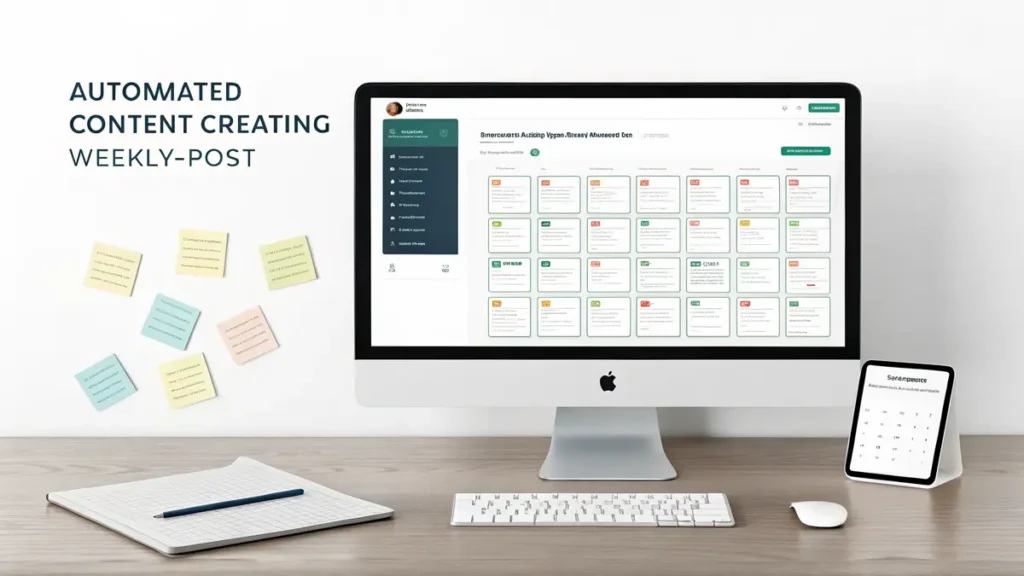
If you want to stop guessing what to post every week, use automated content creation to build a repeatable system. Instead of inventing new ideas from scratch, you turn your offers, customer questions, and brand themes into planned content that supports consistent social media posting and reduces manual effort.
If you keep opening Instagram, LinkedIn, or Facebook and thinking, “What am I supposed to post today?” the problem is not that you are bad at marketing. The problem is that your content process depends on last-minute inspiration. That almost always leads to inconsistent posting, rushed ideas, and long gaps where your business goes quiet.
The fix is not to become more creative on demand. The fix is to stop relying on memory and mood. Automated content creation gives you a repeatable way to turn what your business already knows into content you can publish consistently. If your goal is to stop guessing every week, this is the shift that matters most.
Why you keep running out of post ideas
Most businesses do not actually run out of things to say. They run out of structure.
You probably already have raw material for months of content: customer questions, common objections, service benefits, behind-the-scenes processes, testimonials, mistakes clients make, and opinions about your industry. But if those ideas live only in your head, they are hard to access when it is time to post.
That creates a familiar cycle:
- You wait until you “need” content.
- You try to think of something fast.
- You post whatever feels acceptable.
- You disappear again for days or weeks.
This is why the inconsistent social media posting problem keeps repeating. It is not a motivation issue. It is a system issue. When content depends on manual effort every single time, your visibility becomes unstable.
And unstable visibility usually leads to unstable engagement. People forget you. Platforms stop getting strong consistency signals. Your marketing starts feeling random, even when your business is solid.
What automated content creation actually solves
Automated content creation does not mean pressing a button and flooding the internet with generic posts. At its best, it means building a workflow that takes your business inputs and turns them into useful, repeatable content outputs.
In practical terms, it solves three problems at once.
First, it removes blank-page pressure. You are no longer starting from zero every week. The system pulls from known themes, offers, and audience pain points.
Second, it reduces decision fatigue. Instead of asking, “What should I post?” you ask, “Which content angle should I use from my existing framework?” That is a much easier decision.
Third, it supports consistent social media posting. Consistency is hard when every post is handcrafted from scratch. It becomes much easier when your content engine already knows how to turn one idea into multiple formats.
This is where content automation for business becomes valuable. It helps you move from reactive posting to planned visibility. And planned visibility is what makes content sustainable.

The simple system that replaces weekly guesswork
If you want to stop guessing, you need a simple content system that answers the same questions every week.
Start with four core inputs:
- Your offers: What do you sell, solve, improve, or deliver?
- Your audience questions: What do people ask before they buy?
- Your proof: What results, examples, or stories show that your solution works?
- Your perspective: What do you believe that your ideal customer needs to hear?
From there, assign recurring weekly content themes. For example:
- Monday: common problem
- Tuesday: practical tip
- Wednesday: proof or testimonial
- Thursday: offer-related education
- Friday: opinion, myth, or behind-the-scenes insight
Now your job is no longer to invent five unrelated posts. Your job is to plug one or two business ideas into a structure that already exists.
This is the real power of a small business marketing system. It narrows your choices, which makes execution easier. And easier execution is what creates consistency.
If you want to see what a structured workflow looks like in practice, you can review how SynqBrand works to understand how a content engine can turn simple business inputs into ongoing visibility.
How to turn one business idea into a week’s worth of content
One of the biggest mindset shifts is realizing that you do not need a brand-new topic for every post.
Let’s say your business idea for the week is: “Most small businesses disappear online because they post inconsistently.” That single idea can become multiple pieces of content:
- Educational post: Explain why inconsistency hurts reach and trust.
- Problem-aware post: Describe what inconsistent posting looks like in real life.
- Authority post: Share your process for staying visible without daily manual effort.
- Story post: Show how a client or business owner moved from random posting to a system.
- CTA post: Invite readers to explore a better workflow.
The idea stays the same. The angle changes.
This is how automated content creation helps you scale your thinking. It does not force you to create more ideas. It helps you extract more value from the ideas you already have.
When you build content this way, your weekly planning gets much easier. Instead of asking, “What should I post on five different days?” you ask, “How many useful angles can I pull from this one topic?”
That question is faster, clearer, and far more sustainable.
How to maintain consistent social media posting without burnout
Consistency does not mean posting everywhere, all the time, at maximum volume. It means showing up reliably enough that your audience remembers you and your platforms stay active.
To make that possible, keep your system realistic.
Choose a manageable posting rhythm. Three strong posts every week is better than seven rushed posts followed by silence.
Use platform adaptation, not full reinvention. A single concept can be rewritten for Instagram, LinkedIn, Facebook, X, Pinterest, or Google Business Profile without becoming a completely new project each time.
Batch decisions. Pick themes, prompts, and offers in advance so you are not making strategic choices every day.
Separate creation from publishing. Planning content and posting content are different tasks. When they happen together, everything feels heavier.
This is why many businesses struggle even when they have good intentions. They are trying to be the strategist, writer, editor, scheduler, and publisher at the same time. That is difficult to maintain long term.
A better approach is to create an automated marketing workflow that handles the repetitive parts for you. Then your role becomes input and direction, not constant production.
When to use a done-for-you content automation for business solution
If you understand the framework but still cannot keep up, that is usually the point where a done-for-you system makes sense.
You may need outside support if:
- You regularly go silent for weeks at a time.
- You know your business well but struggle to turn it into content.
- You are manually rewriting the same ideas for different platforms.
- You want visibility, but marketing keeps competing with higher-value work.
- You are tired of guessing and want a process that runs reliably.
A strong content automation for business setup should not make your brand feel robotic. It should make your marketing feel stable. The best systems are built around your business DNA, your offers, and your audience, then distribute content in a way that fits each platform.
That is the difference between random posting and infrastructure.
If that is the shift you need, exploring marketing automation packages can help you compare what level of support fits your stage of growth. And if you are ready to stop managing everything manually, you can get started with a more structured approach.
The main point is simple: you do not need more pressure to “be creative.” You need a system that makes content easier to produce, easier to repurpose, and easier to publish consistently.
Once that system exists, the weekly question changes. You stop asking, “What should I post?” and start asking, “Which proven idea should I run next?” That is when content stops feeling like a guessing game and starts working like an asset.
TL;DR
If you keep guessing what to post every week, the real problem is not creativity. It is the lack of a repeatable system. Automated content creation helps you turn a few core business ideas into planned, platform-specific posts so you can maintain consistent social media posting without starting from scratch every time.
- Weekly content stress usually comes from missing systems, not missing ideas.
- Automated content creation reduces decision fatigue by giving you repeatable content inputs and outputs.
- One business idea can be repurposed into multiple posts across platforms.
- Consistent social media posting becomes easier when content is tied to themes, offers, FAQs, and customer pain points.
- A content automation for business setup works best when it reflects your brand voice and services.
- If manual planning keeps breaking down, a done-for-you automation system may be the fastest fix.
Frequently Asked Questions
Why do I never know what to post for my business?
Usually because you are creating content reactively instead of using a repeatable framework. Without content pillars, prompts, and a posting workflow, every week starts from zero.
Can automated content creation still sound like my brand?
Yes, if the system is built around your offers, tone, audience questions, and real business positioning. Good automation should reduce effort, not erase your voice.
How many content ideas do I need each week?
Fewer than you think. One strong idea can become several posts when you break it into education, proof, opinion, promotion, and engagement angles.
Is content automation for business only for large companies?
No. Small businesses often benefit the most because automation removes the manual marketing bottleneck and helps them stay visible with limited time.
What is the fastest way to achieve consistent social media posting?
Create a simple system with recurring themes, a repurposing process, and scheduled publishing. If you cannot maintain that manually, use an automation solution that handles the workflow for you.