
A marketing automation system helps a small business turn marketing into a repeatable process instead of a daily manual task. It supports social media automation, organizes publishing across channels, and can assist with automated content creation so your business stays visible more consistently with less hands-on effort.
If you have ever wondered what a marketing automation system actually does for a small business, the short answer is this: it replaces scattered, manual marketing tasks with a repeatable system that keeps your business visible. Instead of trying to remember what to post, where to post it, and when to update every platform, you create a process that handles those steps more efficiently.
For most small businesses, that matters because marketing usually breaks down in the same place: consistency. You get busy, content slows down, social channels go quiet, and your business becomes less visible than it should be. That is where social media automation and automated content creation become useful. They do not magically grow your business on their own, but they remove the friction that keeps your marketing inconsistent.
What a marketing automation system actually does
A marketing automation system gives structure to your marketing. At a practical level, it helps you take one idea, offer, update, or piece of expertise and turn it into content that can be distributed across multiple channels without rebuilding everything manually each time.
That means the system can help you:
- capture a content idea quickly
- adapt it for different platforms
- schedule or publish it consistently
- maintain an active presence even when you are busy
- support visibility beyond social media through blog or business profile updates
For a small business, this is less about complexity and more about reliability. A strong system creates a workflow. Instead of asking, “What should I post today?” you operate from a repeatable process that turns your business activity into marketing output.
That is the key difference. A marketing automation system is not just a posting tool. It is an operating system for visibility.
How it fixes the manual marketing bottleneck
The biggest problem small businesses face is not usually a lack of ideas. It is the fact that marketing depends too heavily on your time, memory, and energy. Manual marketing sounds manageable until you are trying to run the business at the same time.
Without a system, marketing often looks like this:
- you think of a post but do not have time to write it
- you post on one platform but skip the others
- you disappear for weeks during busy periods
- you restart from zero every time you try to become consistent again
A marketing automation system removes that bottleneck by reducing repeated work. Instead of creating every post from scratch for every platform, the system helps standardize the flow from idea to distribution. That is where social media automation becomes especially valuable. It keeps your channels active without requiring constant manual effort.
If you are trying to understand how the system works, think of it as replacing random effort with a dependable publishing engine. You still guide the message, but the system handles the repetitive architecture around it.
What gets automated in practice
When people hear automation, they sometimes imagine a black box doing everything on its own. In reality, the most useful systems automate specific parts of the workflow.
For a small business, that often includes:
1. Content adaptation
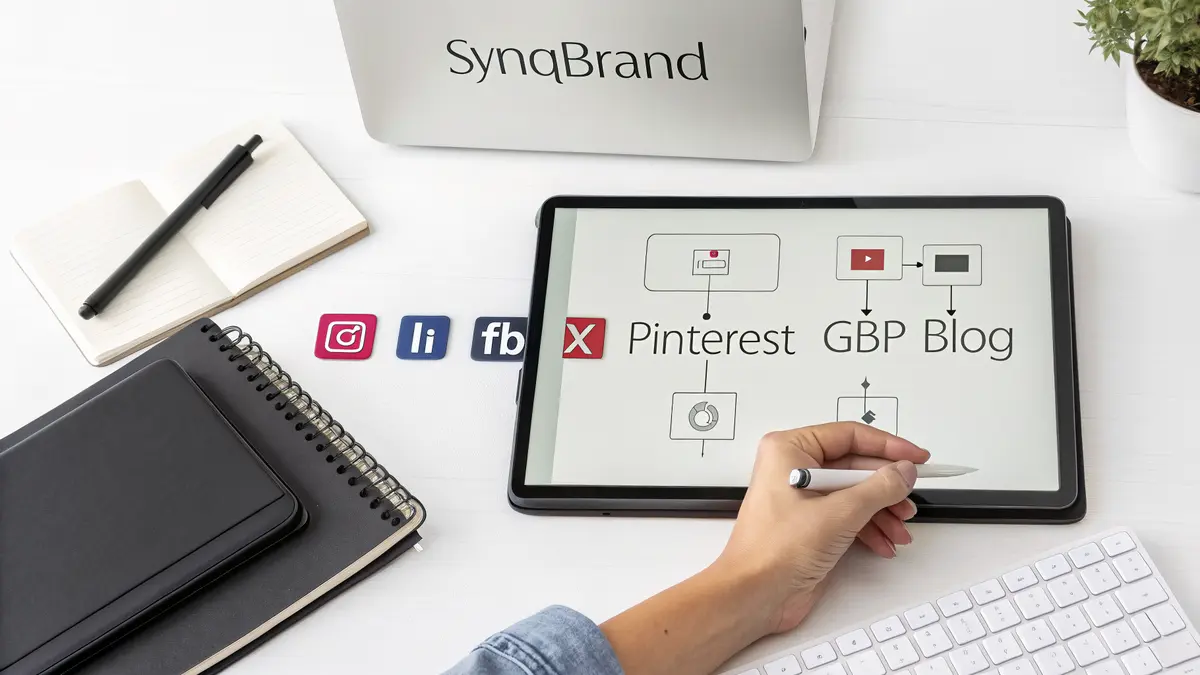
You start with one idea, announcement, tip, or offer. The system helps reshape it for Instagram, LinkedIn, Facebook, X, Pinterest, or Google Business Profile so you are not writing separate versions from scratch.
2. Publishing consistency
Instead of posting only when you remember, the system creates a more regular cadence. This is one of the main reasons businesses use social media automation: it protects consistency when daily operations get busy.
3. Automated content creation support
Automated content creation can help generate starting points, platform-specific angles, and structured drafts based on your business themes. This is especially useful if you struggle with blank-page syndrome or never know what to say.
4. Cross-channel visibility
A more advanced system does not stop at social media. It can support blog publishing and business profile updates so your business stays visible in more places where customers search.
For example, if your goal is broader search visibility, a system that includes Google Business Profile updates can strengthen your local presence alongside your social content. That is important because many small businesses do not just need more posts. They need more discoverability.
What it does not do for you
It is just as important to understand what a marketing automation system does not do.
It does not replace your business strategy. It does not invent a strong offer if your offer is unclear. It does not automatically create trust if your messaging is vague or your service experience is weak. And it does not mean you can disappear completely from your own marketing.
What it does is remove the operational drag.
You still need to provide the substance: your expertise, your positioning, your offers, your customer understanding. The system then helps turn that substance into a consistent output. In other words, automation is not a substitute for knowing your business. It is a substitute for repetitive manual execution.
This distinction matters because some small businesses expect automation to be a magic fix. The better expectation is that it will make good marketing easier to maintain. That is a much more realistic and much more valuable outcome.
How small businesses benefit over time
The main benefit is not just saving time, although that matters. The bigger benefit is that your business becomes more consistently visible.
Over time, a good marketing automation system can help you:
- show up regularly instead of sporadically
- build familiarity with your audience
- reduce the stop-start cycle of manual posting
- repurpose ideas more efficiently
- stay active across channels without multiplying your workload
That consistency changes how your business is perceived. An active, well-maintained presence signals reliability. A silent or outdated presence often creates doubt, even if your business is excellent.
This is why many small businesses eventually realize they do not just need content. They need infrastructure. If your current process depends on you manually pushing every update through every platform, growth will always create friction. A system solves that by making visibility operational instead of optional.
If you are comparing options, reviewing different marketing automation packages can help you see whether you need simple publishing support, ongoing content generation, or a broader visibility system that includes blogs and business profile updates.
How to choose the right system for your business
The right marketing automation system is the one that solves your current bottleneck without adding unnecessary complexity.
Ask yourself:
- Do you mainly struggle with posting consistently?
- Do you need help turning one idea into multiple platform-ready posts?
- Do you want support with automated content creation because you run out of ideas?
- Do you need visibility beyond social media, such as blogs or Google Business Profile?
- Do you want a tool, or do you want an installed workflow that actually runs?
For many small businesses, the best solution is not another dashboard to manage. It is a system that fits how the business already operates and removes the manual bottleneck with minimal extra effort.
That is where a service like SynqBrand can make sense. Rather than simply giving you a scheduling tool, it focuses on building an autonomous marketing infrastructure around your business so your visibility does not depend on daily manual posting. If that sounds like the next step you need, you can get started or explore the main platform at SynqBrand.
In the end, what a marketing automation system actually does is simple: it makes marketing repeatable. For a small business, that can be the difference between being occasionally active and being consistently seen.
TL;DR
A marketing automation system helps your small business stay visible without relying on manual posting every day. It turns your ideas, offers, and updates into a repeatable publishing workflow across channels, supports social media automation, and can extend into automated content creation for blogs and business listings. The real value is consistency, speed, and reduced marketing friction.
- A marketing automation system creates a repeatable workflow for publishing, repurposing, and scheduling content.
- It reduces the time and inconsistency problems that come with manual marketing.
- Social media automation helps you stay active across platforms without rebuilding every post from scratch.
- Automated content creation can support idea generation, formatting, and channel-specific adaptation.
- The best systems still need your input, positioning, and business direction.
- For small businesses, the biggest gain is reliable visibility with less daily effort.
Frequently Asked Questions
Is a marketing automation system only for large companies?
No. Small businesses often benefit the most because they usually have the least time for manual marketing. A good system removes repetitive work and helps you stay visible consistently.
Does social media automation make content feel robotic?
It can if it is poorly set up. But when the system is based on your real offers, voice, and audience, automation improves consistency without removing relevance.
What is the difference between scheduling posts and a full marketing automation system?
Scheduling is one small feature. A full marketing automation system handles workflow, repurposing, channel adaptation, publishing consistency, and sometimes automated content creation for blogs or business profiles.
Can automated content creation replace my input completely?
No. It can speed up execution and reduce blank-page problems, but your business still needs direction, expertise, and approval to stay accurate and useful.
How quickly can a small business see results?
You may notice time savings immediately. Visibility and engagement usually improve over time as your business posts more consistently and appears in more places.