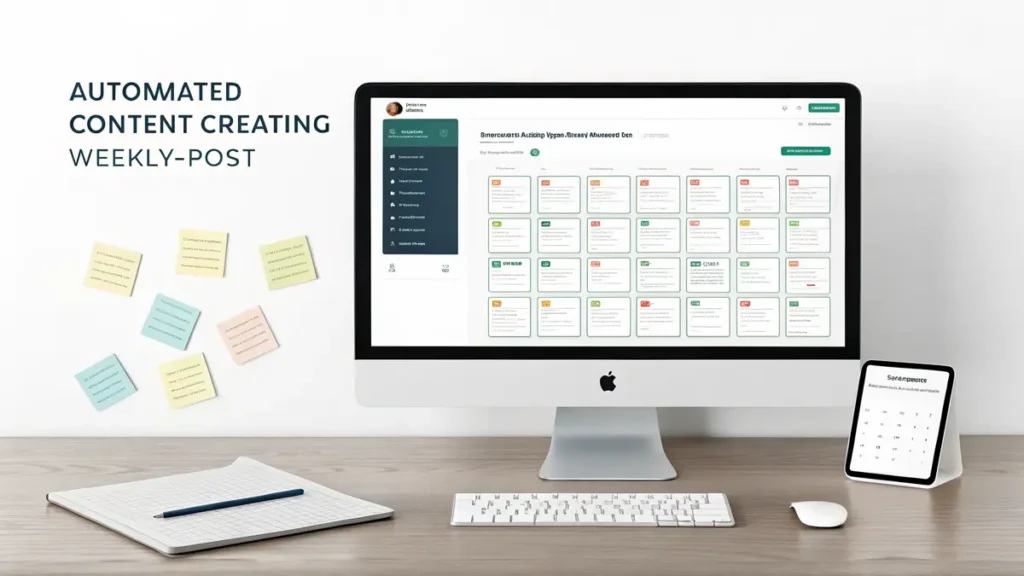

If you know marketing matters but keep putting it off, the problem is usually not commitment. It is that your process is too manual to sustain. The most effective fix is to reduce friction with automated content creation and content automation for business, so your marketing keeps moving even when your schedule gets full.
You already know marketing matters. That is not the issue. The issue is that it keeps sliding behind client work, operations, admin, and everything else that feels more urgent in the moment.
If that sounds familiar, you do not need another lecture about consistency. You need a practical fix for the real problem: your marketing likely depends on too much manual effort. When every post, update, caption, idea, and blog starts from zero, it becomes easy to delay. That is exactly why automated content creation has become so useful for businesses that want stronger digital visibility for small business without turning marketing into a second full-time job.
Why you keep putting marketing off even when you know it matters
Most business owners do not avoid marketing because they think it is unimportant. They avoid it because it feels mentally expensive.
Marketing is one of those tasks that is never fully done. There is always another post to write, another platform to update, another idea to come up with, another week to plan. That makes it easy for your brain to label it as something you can do later.
There are usually a few reasons this happens:
- You do not have a clear process, so every session starts with decision fatigue.
- You are trying to create for multiple platforms manually.
- You feel pressure to make everything polished before publishing.
- You only market when you finally have spare time.
- Your business depends on you to do every step.
That combination creates friction. And friction creates delay.
The important shift is this: stop treating procrastinated marketing like a personal flaw. In many cases, it is a workflow problem. Once you see that, the solution becomes much clearer.
What procrastinated marketing is really costing you
When marketing gets postponed for a few days, it may not seem serious. But when it becomes a pattern, the cost compounds quietly.
First, your visibility drops. If people are not seeing your business regularly, they are less likely to remember you when they are ready to buy. This is especially important if you rely on social platforms, search presence, or local discovery.
Second, inconsistency affects trust. A business that posts once, disappears, then returns weeks later can look inactive or distracted. Even if you are doing great work behind the scenes, your online presence may tell a different story.
Third, you lose momentum. Marketing works better when it stacks. One useful post leads to another touchpoint. One blog supports search. One update reinforces authority. When long gaps interrupt that pattern, you keep restarting instead of building.
This is where digital visibility for small business becomes less about creativity and more about reliability. Visibility is not only about having good ideas. It is about showing up often enough that people can find you, recognize you, and trust that you are active.

Why willpower is not a real marketing system
A lot of business owners try to solve this with better intentions. They promise themselves they will post three times a week, write blogs every month, or finally stay on top of content planning.
That works for a short time. Then real life takes over.
Willpower is unreliable because your schedule is unreliable. If your marketing only happens when you feel focused, inspired, and available, it will always be vulnerable to interruption.
A real system does something different. It reduces the number of actions required from you. It turns marketing from a recurring burden into a repeatable process.
That is why many businesses move toward a systemized marketing workflow instead of trying to force more discipline. The goal is not to become a more motivated marketer. The goal is to make marketing easier to execute consistently.
In other words, if your current approach depends on remembering, planning, writing, designing, and publishing everything manually, you do not have a consistency problem. You have a structure problem.
What to do if you cannot keep up manually
If manual marketing keeps getting pushed aside, the answer is not to lower your standards or ignore marketing altogether. The answer is to simplify the path from idea to published content.
Start by looking at where the bottleneck actually is. For most businesses, it is one or more of these points:
- Coming up with content ideas
- Adapting one idea for different platforms
- Writing captions and post copy
- Publishing consistently across channels
- Keeping blog and Google Business Profile activity current
Once you identify the bottleneck, you can stop trying to solve everything at once.
For example, if you have ideas but never turn them into published content, you do not need more brainstorming. You need a process that converts one idea into multiple usable assets. If you can post on social but never keep up with search visibility, you may need a workflow that also supports blog content and profile updates.
This is where content automation for business becomes practical. It is not about removing your voice. It is about removing the repetitive production steps that keep stopping you from showing up.
If you are comparing options, reviewing different marketing automation packages can help you see what level of support fits your current stage without overcomplicating the solution.
How automated content creation reduces the bottleneck
Automated content creation works best when it solves a very specific problem: the gap between knowing you should market and actually getting content published.
Instead of asking you to build every piece manually, a good system helps you move faster from raw input to finished output. That might mean turning one idea into platform-specific posts, generating consistent content prompts based on your business, or supporting blog and profile publishing without requiring constant hands-on effort.
The benefit is not just speed. It is continuity.
With content automation for business, you are less likely to disappear online every time you get busy. Your marketing becomes less dependent on your daily energy and more dependent on the system you have in place.
That matters because consistency creates compounding returns:
- More opportunities for people to discover your business
- Stronger brand familiarity over time
- Better support for search visibility
- A more active and trustworthy online presence
- Less stress around what to post next
For businesses that also care about local search, keeping your Google Business Profile visibility active can be part of that same consistency strategy. The less fragmented your marketing process is, the easier it becomes to stay visible everywhere that matters.
The key is to think of automation as infrastructure, not a shortcut. Done well, it does not replace strategy. It supports execution.
The simplest next step you can take this week
If you have been putting marketing off for months, do not respond by creating a huge plan you will also postpone. Start smaller.
Your next step is to remove one layer of friction.
That could mean choosing one source of content input, one publishing workflow, or one system that helps you stay visible without rebuilding the process every week. The goal is to make marketing easier to continue, not harder to perfect.
Ask yourself:
- What part of marketing do I delay most often?
- What part feels repetitive enough to systemize?
- What would make publishing feel lighter and faster?
If your honest answer is that manual marketing is the bottleneck, then it may be time to stop trying to outwork the problem. A better structure can do more for your consistency than another burst of motivation.
That is the role of a business like SynqBrand: not just helping you post, but helping you remove the manual marketing bottleneck through a more autonomous system. If you want to see what that looks like in practice, you can get started here or explore the main platform at SynqBrand.
The real win is simple: marketing no longer sits on your to-do list waiting for the perfect moment. It keeps moving, and your business stays visible while you focus on running it.
TL;DR
You are not putting marketing off because you do not care. You are usually delaying it because your current process is too manual, too fragmented, and too dependent on finding extra time. The fix is not more guilt. It is a simpler system. For many small businesses, automated content creation and content automation for business make marketing easier to start, easier to repeat, and much more reliable for long-term digital visibility for small business.
- Marketing procrastination is often a systems problem, not a motivation problem.
- When marketing is inconsistent, your business loses visibility, trust, and momentum.
- Relying on spare time and discipline creates a fragile marketing routine.
- Automated content creation helps reduce the manual workload that causes delay.
- A good content automation for business setup turns one idea into repeatable visibility.
- The best first step is to build a process so marketing happens even when you are busy.
Why do I keep avoiding marketing even though I know I need it?
Usually because marketing feels open-ended, time-consuming, and hard to finish. If every post, update, or blog starts from scratch, your brain treats it like a heavy task and keeps pushing it back.
Is inconsistent marketing really that harmful for a small business?
Yes. Inconsistent activity weakens your visibility, makes your business look less active, and reduces the number of opportunities people have to discover or trust you.
What is the best way to stay consistent with marketing?
The most reliable way is to remove as much manual effort as possible. A repeatable workflow or automated content creation system is usually more dependable than trying to stay motivated every week.
How does content automation for business help?
It reduces the number of decisions and tasks required to publish. Instead of creating every asset manually, the system helps generate, adapt, schedule, and distribute content consistently.
Will automation make my marketing feel generic?
Not if it is built around your business, offers, and voice. Good automation supports consistency and structure while still using your real ideas and positioning.