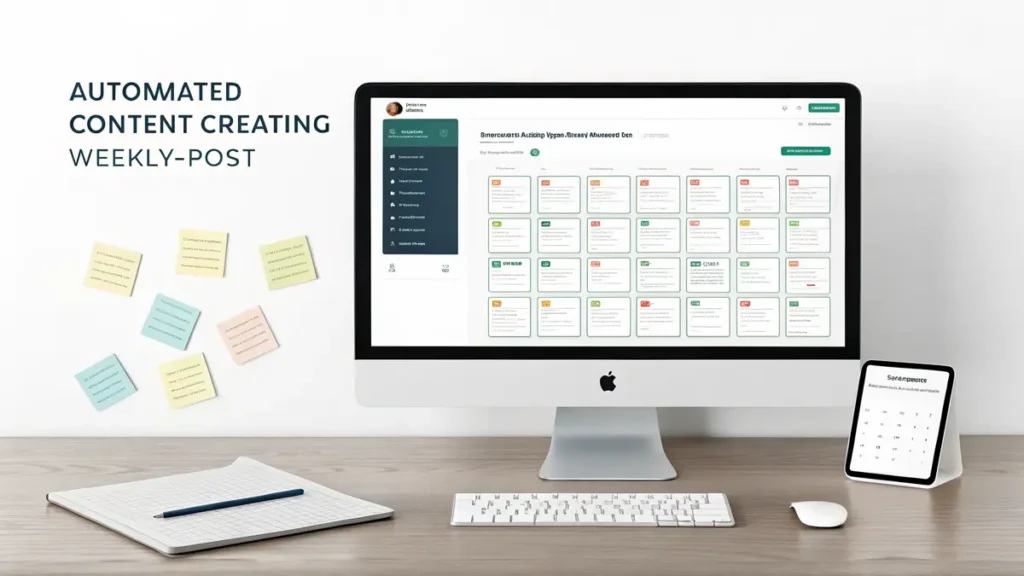

Your content can feel productive but still bring no customers when it creates activity without enough visibility, repetition, or trust. For most owners, the real issue is weak digital visibility for small business growth: inconsistent posting, limited distribution, and no marketing automation system to support consistent social media posting across channels.
You can spend hours writing captions, making graphics, filming short videos, and planning posts, then still wonder why none of it turns into inquiries or sales. If that sounds familiar, the problem usually is not that you are lazy or that content marketing never works. The problem is that your effort feels productive on the inside while remaining mostly invisible on the outside.
That is why so many owners stay stuck. You are creating content, checking the box, and staying busy, but customers are not moving closer to a decision. In most cases, the missing piece is digital visibility for small business growth: enough consistent exposure, across enough relevant places, for people to remember you, trust you, and act when they are ready.
Why busy content does not create demand
Content creation feels productive because it is tangible. You can point to the reel, the post, the photo, the caption, or the calendar and say, “I did the marketing.” But customers do not respond to effort. They respond to what they repeatedly see, understand, and trust.
This is where many small businesses get misled. You may be producing content regularly enough to feel active, but not strategically enough to create momentum. One post here, a missed week there, a few stories, then silence. That pattern creates work without building market presence.
Demand is rarely created by isolated acts of posting. It is created by repeated, recognizable visibility. If people only see you occasionally, they do not build familiarity. If they do not build familiarity, they do not remember you. And if they do not remember you, they do not buy from you when the need appears.
So when you ask why your social media is not working for business, the answer is often simple: your content exists, but your presence does not.
The real problem is a visibility gap
A visibility gap happens when the amount of effort you put into marketing is much higher than the amount of attention your business actually earns. This gap is common when content depends entirely on your time, energy, and memory.
You may have good ideas. You may even have strong offers. But if your marketing only appears when you have a free hour, your audience experiences your business as inconsistent. From their point of view, you are present, then absent, then present again. That weakens trust before a sales conversation even starts.
Digital visibility for small business growth is not just about “being online.” It is about being seen often enough, in enough places, with enough consistency that your business feels active and credible. That includes social platforms, search surfaces, and business listings. If one piece of content lives in one place and disappears in a day, its business value is limited.
This is also why distribution matters as much as creation. A single idea can become multiple touchpoints when it is adapted across platforms. If you want to understand how the system works in a more structured way, the core principle is simple: one idea should not produce one post; it should produce ongoing visibility.

Productive marketing vs customer-generating marketing
There is a big difference between marketing that keeps you occupied and marketing that helps customers move toward action.
Productive-feeling marketing usually looks like this:
- Creating content from scratch every time
- Posting only when inspiration hits
- Focusing on output instead of reach
- Treating each platform as a separate job
- Letting good content die after one use
Customer-generating marketing looks different:
- It repeats core messages consistently
- It shows up across multiple channels
- It reduces gaps between posts
- It supports search and social visibility together
- It makes your business easier to remember
The reason this matters is that customers rarely convert on first contact. They notice, scroll, compare, forget, remember, revisit, and then decide. If your content process cannot support that journey, it may still feel productive while producing very little commercial result.
That is especially true for service businesses and local brands. People often check your social presence, your website, and your business profile before they reach out. If those surfaces look inactive, trust drops. Strengthening things like Google Business Profile visibility alongside social activity helps close that trust gap.
Why inconsistency breaks trust and memory
The most expensive problem in small business marketing is not always poor content. Often, it is inconsistency.
Inconsistent social media posting creates three problems at once. First, it weakens memory. People forget businesses that disappear. Second, it weakens trust. Silence can make your business feel stalled, overwhelmed, or unreliable. Third, it weakens platform performance. Most channels reward regular activity more than occasional bursts.
This is why many owners feel trapped. They know they need to keep showing up, but manual posting is hard to sustain. Content becomes another recurring task competing with sales, operations, fulfillment, and client work. Eventually, marketing slips again.
When that happens, your results do not just pause. They often reset. Every long gap forces you to rebuild attention from scratch. That is why consistent social media posting is not a cosmetic best practice. It is part of how your business stays mentally available to buyers.
If your current process depends on finding time every day or every week, then your visibility is fragile. And fragile visibility rarely produces steady customers.
What a marketing automation system actually fixes
A marketing automation system does not magically make bad messaging good. What it does is remove the manual bottleneck that causes good businesses to go quiet.
That matters because most small business marketing problems are execution problems, not idea problems. You already know your business. You already have offers, insights, updates, and proof points worth sharing. The issue is turning those into a reliable publishing rhythm without draining your time.
A strong system helps in a few practical ways:
- It turns one idea into multiple platform-ready assets
- It reduces the stop-start cycle of manual posting
- It supports consistent social media posting without daily effort
- It keeps your brand active across the channels customers check
- It extends visibility beyond social into search-oriented surfaces
In other words, automation is not just about convenience. It is about preserving presence. Instead of asking, “Do I have time to post today?” you create a structure where your business continues to show up even when your attention is elsewhere.
For many owners, that is the shift that finally makes marketing feel connected to revenue. Not because automation replaces strategy, but because it allows strategy to actually appear in public on a consistent basis.
How to shift from content output to customer visibility
If your content feels productive but brings no customers, the fix is not automatically “make more content.” The better move is to redesign your process around visibility.
Start with these questions:
- Are you visible often enough to be remembered?
If your audience sees you sporadically, memory will stay weak. - Are you distributing one idea across multiple places?
If every post is single-use, you are wasting effort. - Does your marketing continue when you get busy?
If not, your system is too dependent on your availability. - Do your channels reinforce each other?
Your website, social presence, and business profile should all support trust.
From there, build a process that values repetition, adaptation, and consistency over constant reinvention. You do not need endless originality. You need reliable presence.
This is where a system-based approach can help. SynqBrand, for example, is built around removing the manual marketing bottleneck so your business stays active across platforms instead of disappearing whenever your schedule tightens. If you want to compare options, you can review the available marketing system packages or get started when you are ready.
The bigger point is this: customers do not reward content that merely took effort to make. They respond to businesses that stay visible long enough to earn attention and trust. Once you shift your focus from “Did I post something?” to “Is my business consistently visible where buyers look?” your marketing decisions get much clearer.
And that is usually the real answer to why your content feels productive but still brings no customers.
If you want a simpler next step, look at your last 30 days of marketing activity. Count how many times your business was truly visible across the places customers check, not just how many pieces of content you created. That number will tell you more than your effort ever could.
TL;DR
Your content can feel productive because it takes time, planning, and effort, but still fail to bring customers if it never creates enough visibility, repetition, and relevance. Most small businesses do not have a content problem; they have a distribution and consistency problem. A marketing automation system helps turn scattered effort into consistent social media posting and broader digital visibility for small business growth.
- Posting content is not the same as becoming visible where buyers actually notice you.
- Low results often come from weak distribution, inconsistent publishing, and disconnected channels.
- Customers usually need repeated exposure before they trust or remember your business.
- Consistent social media posting matters because silence resets momentum.
- A marketing automation system reduces the manual bottleneck that causes inconsistency.
- The goal is not more content for its own sake; it is sustained visibility that supports buying decisions.
Why does my business get no customers even though I post often?
Because frequency alone does not guarantee visibility or conversion. If your content is inconsistent, limited to one platform, poorly distributed, or not aligned with what buyers need to see repeatedly, it can stay busy without creating demand.
Is consistent social media posting really that important?
Yes. Consistency helps people remember your business, builds trust over time, and increases the chances that your content appears when someone is ready to buy. Long gaps make your business easier to forget.
What is the difference between content creation and digital visibility for small business?
Content creation is making the asset. Digital visibility is making sure that asset is seen repeatedly across the places your audience already spends time, including social platforms and search surfaces.
Can a marketing automation system replace strategy?
No. Strategy still matters. But a marketing automation system can make a good strategy execute consistently, which is where many small businesses struggle.
How do I know if my problem is a visibility issue instead of a content quality issue?
If your content is decent but posting is irregular, limited to one channel, or dependent on your available time each week, visibility is likely the bigger issue. Many businesses are under-seen, not under-talented.